Smart toilets depend on more than sleek controls and warm-water features. A reliable Smart Toilet Pump helps move water or wastewater where the design requires it, often through compact, concealed plumbing. Its performance can affect flushing, drainage, noise, and long-term maintenance. Small parts matter.
In 2026, buyers comparing pump suppliers should look beyond product photos and broad performance claims. Useful checks include flow rate, lift height, operating noise, materials, duty cycle, and compatibility with the toilet’s control system. Ask for current technical documents and confirm how performance was tested. A specification sheet is helpful, but it does not answer every installation question.
This guide examines leading supplier options by product focus, manufacturing capabilities, customization, quality documentation, and after-sales support. It also distinguishes pump manufacturers from trading companies and broader bathroom-equipment brands, since their capabilities may differ. “Top” is not a universal ranking; the right choice depends on the application, order volume, and service expectations. Supplier details can change, and public information may be incomplete. That deserves a second look. Use the comparisons as a starting point, then verify specifications, samples, lead times, and warranty terms directly before making a purchasing decision.
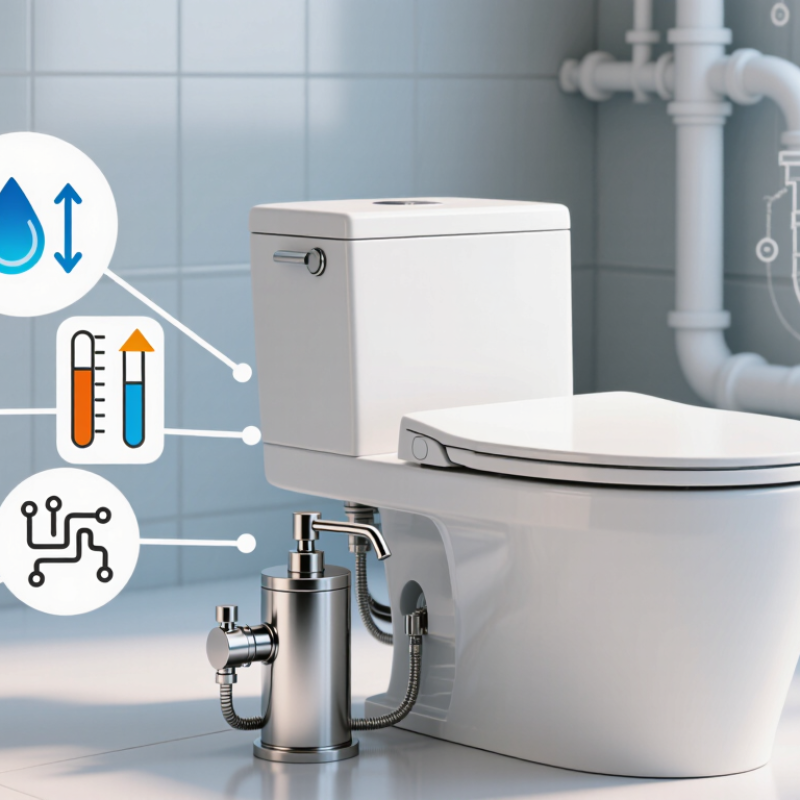
Smart Toilet Pump Basics: Flow Rate, Head, Pressure, and Power Ratings
Smart toilet pump ratings are useful only when read together. Flow rate describes water delivered per minute; head describes the energy available to move it. A pump rated at 6 L/min may not deliver that flow against a tall, narrow hose. For water, 1 metre of head equals about 9.8 kPa, so 3 metres represents roughly 29 kPa before friction losses. Small numbers matter. Check the rated flow and head at the same operating point, not as separate maximum values.
Power is the input; hydraulic power is the useful work delivered to water. At 6 L/min and 3 metres of head, hydraulic output is about 2.9 watts. At 30% overall efficiency, input power is roughly 10 watts, before accounting for control electronics. Treat this as an estimate, not a product rating. The U.S. Department of Energy’s 2006 Improving Pumping System Performance sourcebook reports that pumping systems can consume 25–50% of electricity in some industrial facilities; that figure is not a toilet-pump benchmark, but it shows why efficiency deserves attention. Ask suppliers for test conditions, pressure curves, noise, and startup current. Real installations add bends, filters, and fluctuating inlet pressure. Those details are easy to overlook.
These illustrative operating points show how flow rate and head determine ideal hydraulic output. Hydraulic power is calculated as ρgQH, assuming water density of 1,000 kg/m³; actual electrical input is higher because pumps are not perfectly efficient. Values are calculations, not supplier measurements or product specifications.
2026 Supplier Comparison: Rated Flow, Noise, Warranty, and Production Capacity
What Are the Top Smart Toilet Pump Suppliers in 2026?
A useful 2026 supplier comparison starts with rated flow, but the number only matters at a stated pressure and lift. Ask for a pump curve, not just a maximum-flow figure. For example, a pump rated at 18 liters per minute may deliver less when pushing wastewater through a long, narrow pipe. Test the same operating point across suppliers. Small detail, big difference.
Noise figures need equal care. A rating of 45 dBA sounds precise, yet distance, room surfaces, and test cycles can change the result. Request the test method and, where possible, a recording from a complete toilet installation. A bare pump on a workbench may sound quieter than one mounted inside a bathroom cabinet. That comparison is imperfect, but still useful.
Warranty terms should state what is covered, how claims are handled, and whether labor or replacement parts are included. Production capacity deserves similar evidence: monthly output, current lead time, and capacity reserved for your order are more useful than a factory’s headline figure. Request recent production records or an audit summary. Numbers can look tidy on a spreadsheet. They do not always predict delivery. Combine these checks with sample testing, since rated flow and low noise matter little if performance changes after repeated flushing.
Safety Review: IEC 60335-2-84 and IPX4 Protection Ratings
What Are the Top Smart Toilet Pump Suppliers in 2026?
Safety Review: IEC 60335-2-84 and IPX4 Protection Ratings
When comparing smart toilet pump suppliers in 2026, ask for safety evidence tied to the exact product model. IEC 60335-2-84 covers safety requirements for electrically operated toilets and related features. A supplier should provide a traceable test report, identify the tested configuration, and explain any differences between it and the unit being quoted. A certificate alone may not show whether the pump, wiring, and controls were assessed together. Details matter.
IPX4 indicates protection against splashing water from any direction under specified test conditions. It does not mean the pump can be submerged or cleaned with a high-pressure jet. Check which parts carry the rating: a control enclosure may differ from a connector or motor assembly. Ask how cable entries are sealed and whether the rating applies after installation. That distinction is easy to miss.
Tips: Request the report number, test date, and applicable standard edition. Compare labels on the sample unit with the paperwork. Ask about routine production checks, not just prototype testing. If a supplier cannot explain a gap clearly, pause and verify it independently. Supplier claims are useful, but they are not the same as verified evidence.
Water-Efficiency Benchmark: The 1.28-gpf WaterSense Limit
What Are the Top Smart Toilet Pump Suppliers in 2026?
Water-Efficiency Benchmark: The 1.28-gpf WaterSense Limit
For smart toilets, 1.28 gallons per flush is a useful efficiency benchmark, not a pump rating. The U.S. Environmental Protection Agency’s WaterSense specification sets this maximum for labeled tank-type toilets. It also requires tested flush performance of at least 350 grams under the MaP protocol. EPA reports that WaterSense toilets use at least 20 percent less water than standard 1.6-gpf models. That distinction matters. A pump supplier can influence pressure, refill behavior, and consistency, but the complete toilet must meet the volume and performance criteria.
When comparing pump suppliers, ask for test results across realistic inlet pressures and repeated flush cycles. Check whether the stated water volume remains stable after many cycles, not just during a single demonstration. Listen for pump noise in a small bathroom, and inspect how easily service parts can be reached. Small details count. A low-volume flush that leaves residue is not an efficiency win. One practical question is often missed: does the supplier document the pump’s performance inside the finished toilet, rather than only on a test bench? EPA’s benchmark gives buyers a clear target, but actual results still depend on system design and installation.
What Are the Top Smart Toilet Pump Suppliers in 2026? - Water-Efficiency Benchmark: The 1.28-gpf WaterSense Limit
Supplier-neutral comparison framework. The figures below describe U.S. toilet-efficiency benchmarks and evaluation criteria; they are not rankings or claims about individual suppliers.
| Comparison Dimension |
Verified Benchmark or Data |
How to Evaluate a Pump Supplier |
| WaterSense flush-volume limit |
Qualifying tank-type toilets use no more than 1.28 gallons per flush (gpf), approximately 4.8 liters per flush. |
Confirm the complete toilet model—not just its pump—has current WaterSense certification when a WaterSense claim is made. |
| U.S. baseline comparison |
The commonly used federal baseline for conventional toilets is 1.6 gpf. Reducing flush volume from 1.6 to 1.28 gpf is a 20% reduction per flush. |
Check that pump operation supports the stated flush volume without requiring additional flushes under the intended operating conditions. |
| Flush performance |
WaterSense tank-type toilet criteria include a minimum waste-removal performance of 350 grams per flush, in addition to the water-use limit. |
Request test documentation for the assembled toilet and its flush system; water volume alone does not establish flushing performance. |
| Independent verification |
WaterSense-labeled products are certified by an EPA-approved third-party certifying body against applicable efficiency and performance requirements. |
Verify the product listing, certification scope, model number, and test records rather than relying only on a component supplier’s marketing material. |
| Pump electrical demand |
There is no single WaterSense pump-wattage limit for smart toilets; pump power depends on the product design and operating mode. |
Compare rated and measured power in watts, duty cycle, standby draw, and the test conditions reported in the technical datasheet. |
| Flow and pressure data |
Pump flow rate and pressure are model- and system-dependent; there is no universal WaterSense flow or pressure rating for smart-toilet pumps. |
Compare flow and pressure at stated operating points, required inlet conditions, and compatibility with the finished toilet system. |
| Reliability and serviceability |
WaterSense certification does not establish a pump’s service life, repair cost, or warranty duration. |
Compare documented endurance-test conditions, warranty terms, spare-part availability, repair procedures, and technical support coverage. |
Note: WaterSense is a toilet-product efficiency and performance certification, not a standalone pump certification. Always check the current EPA specification and the certification listing for the exact toilet model.
Supplier Due Diligence: Certifications, Reliability Data, and After-Sales Support
A smart toilet pump supplier should be judged by evidence, not a polished catalog. Ask for certificates tied to the exact pump model and intended use; a factory-wide certificate proves little about one component. Where parts contact drinking water, verify applicable NSF/ANSI/CAN 61 documentation. For wastewater applications, check the relevant plumbing and electrical requirements instead. Request dated test reports, traceable batch records, and clear pass/fail criteria.
Reliability data should include pump-cycle tests, operating temperature, noise, leakage, and failure rates. Ask how many units were tested and under what water pressure. The U.S. Department of Energy’s Improving Motor and Drive System Performance sourcebook reports that motor-driven systems account for about 68% of electricity use in U.S. manufacturing. That figure is not a toilet-pump benchmark, but it underlines why motor efficiency and heat management deserve scrutiny. One gap often remains: suppliers may share a warranty period but not claim rates or repair times.
Tips: Request anonymized warranty claims by failure type, spare-parts lead times, and a written escalation path. Check whether service staff can diagnose a weak flush from pressure and flow readings, not guesswork. A small pilot batch helps reveal fit and noise issues before a full order. Ask for references from comparable installations, then verify them independently.
Conclusion
Choosing a Smart Toilet Pump in 2026 requires looking beyond basic compatibility. Buyers should compare rated flow, head, pressure, and power to ensure the pump can deliver reliable flushing performance under the intended operating conditions. Supplier comparisons should also consider noise levels, warranty terms, and production capacity, since these affect user comfort, long-term support, and the ability to meet demand.
Safety and efficiency are equally important. Review whether products are tested against relevant electrical-appliance safety requirements, including IEC 60335-2-84, and whether their enclosure offers suitable protection, such as an IPX4 rating where applicable. For water efficiency, assess how the pump supports toilets designed to operate at or below 1.28 gallons per flush. Before selecting a supplier, verify certifications, request reliability and performance data, and evaluate the availability of responsive after-sales support. Together, these checks help identify a dependable solution suited to both product requirements and long-term use.