Automotive & Appliance Fluid Dynamics Whitepaper

China Small Transfer Pump for Water Supplier & Engineering Matrix

An exhaustive technical specification manual and procurement directory covering high-reliability Brushless DC (BLDC) micro-pumps, smart sanitary pressurization, EV thermal cooling loops, and high-efficiency water heating circulation architectures.

Industry Intelligence & Evolution

The Micro-Fluidics Revolution: Evolution of Small Water Transfer Pumps

Analyzing why global manufacturing centers have decisively migrated from traditional brushed DC motor configurations to magnetic-drive Brushless DC (BLDC) architectures in fluid transfer.

In modern electromechanical design, the designation small transfer pump for water has evolved far beyond rudimentary displacement mechanisms. Across international appliance manufacturing, clean-energy transportation, and precision climate equipment, engineering teams demand higher energy density, near-silent acoustic performance, and maintenance-free life expectancies exceeding 30,000 to 50,000 continuous operating hours. Traditional brushed architectures suffer inherently from mechanical friction, carbon brush dust deposition, electrical arcing, and commutator thermal breakdown. In contrast, modern China-based manufacturing hubs—anchored by facilities like Xiamen Reto Electric Appliances Co., Ltd.—have established leadership in magnetic coupling, electronic commutation, and wet-rotor canned drive integration.

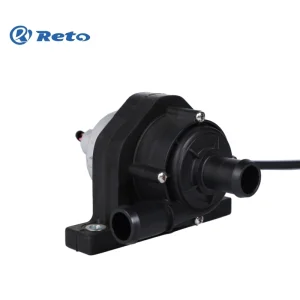
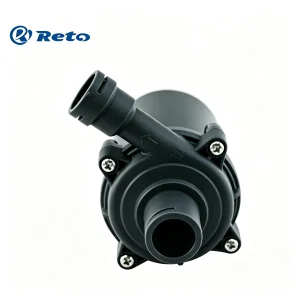
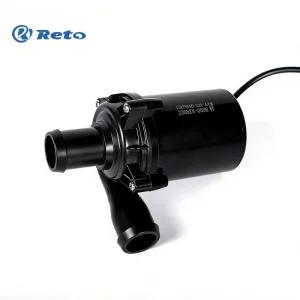
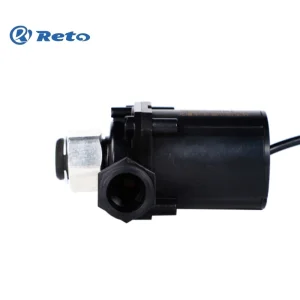
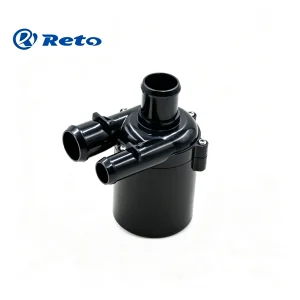
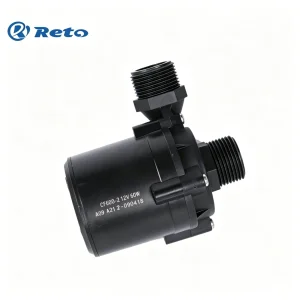
A true brushless DC small transfer pump utilizes a static stator winding separated from the fluid by a hermetically sealed non-magnetic isolation sleeve. The impeller and permanent magnet rotor rotate harmoniously on high-purity ceramic shafts lubricated entirely by the pumped medium itself. This completely eliminates dynamic shaft seals, addressing the primary point of failure—seal degradation and fluid ingress—responsible for over 82% of mechanical failures in legacy water transfer modules.

Hermetic Canned Isolation
Static O-ring containment separating wet rotor from dry stator windings, preventing leaks across 100% of the operational lifespan, even under cycling pressures up to 10 Bar.
FOC Vector Drives
Integrated Field-Oriented Control (FOC) algorithms regulating commutation angles dynamically, minimizing torque ripple and achieving system efficiency levels north of 85%.
Acoustic Suppression <28 dB(A)
Precision-balanced impellers paired with liquid-cushioned Al2O3 or ZrO2 ceramic bearings eliminate mechanical resonance, meeting stringent residential sleep and sanitation codes.

Furthermore, the modern supply chain in China offers rapid algorithmic adaptations: pumps can feature built-in dry-run protection, stall recovery logic, over-voltage clipping, reverse polarity safeguards, and pulse-width modulation (PWM) speed regulation directly embedded onto micro-circuit assemblies. This level of responsiveness is vital for tier-1 original equipment manufacturers (OEMs) seeking drop-in fluid management solutions.

Sourcing & Procurement Guidelines

Global Enterprise Procurement Matrix: Engineering Selection Parameters

A rigorous comparative framework for mechanical, electrical, and thermal engineers evaluating suppliers for critical small water transfer applications.

Procuring micro-pumps at industrial scale requires multidimensional evaluation beyond static head and open-flow specifications. OEM engineers must reconcile hydrodynamic duty curves (H-Q curves) against actual fluid loop impedance, fluid viscosity variations across temperature extremes, cavitation vulnerability (Net Positive Suction Head Required - NPSHr), and ambient vibration profiles.

2,000,000+
Annual Unit Output
100+
Proprietary Patents
100%
Automated Process QC
>30,000 h
Verified MTBF Rating
Evaluation Parameter RETO Precision BLDC Canned Pump Standard Commercial Brushed Pump Traditional AC Shaded-Pole Pump
Operational Service Life (MTBF) 30,000 to 50,000 Continuous Hours 1,200 to 3,000 Hours (Brush Burnout) 8,000 to 12,000 Hours (Bearing Wear)
Acoustic Footprint (1m distance) < 26 – 32 dB(A) Smooth Sound Profile > 45 – 55 dB(A) High Commutator Whine > 40 – 48 dB(A) Low-frequency 50/60Hz Hum
Electro-Mechanical Efficiency 75% – 88% (Low Thermal Dissipation) 35% – 50% (High Rotor Heat Losses) 18% – 30% (Severe Electrical Inefficiency)
Control Signal Interfacing PWM, 0-5V DC, FG Speed Output, CAN/LIN Voltage Dropping (Unstable at low speeds) Triac / Phase angle cut only (Bulky)
Ingress & Thermal Protection IP68 Hermetic Epoxy Resin Potting IP44 – IP54 (Ventilation holes required) IP54 Standard Enclosure
Operating Fluid Temperature Range -20°C up to +105°C (Food/Auto Grade Polymers) 0°C up to +60°C (Restricted by thermal load) 0°C up to +80°C (High self-heating risk)

When selecting a qualified China small transfer pump for water supplier, tier-1 procurement directors focus heavily on raw material traceability. For instance, pump wet-ends built with glass-fiber reinforced polyphenylene sulfide (PPS) or polyarylamide (PARA) maintain dimensional stability without warping under hot water thermal cycles, ensuring rotor gap clearance tolerances within ±0.03 mm throughout extended run cycles.

Application Frameworks

Macro-Industry Solutions: Integrating Small Transfer Pumps at Scale

Cross-sector engineering case profiles where RETO BLDC fluid transfer platforms resolve complex hydrodynamic, thermal, and space constraints.

Smart Sanitary & Bidets
Equipped with 12V/24V high-flow micro-booster designs that stabilize spray pressure regardless of city main pressure drops. Integrated anti-siphon and instantaneous response mechanisms ensure user safety and comfort.
EV Thermal Coolant Loops
Manufactured under stringent IATF 16949 standards, circulating ethylene glycol/water mixes across battery packs, power electronics (inverters), and cockpit heating systems under extreme ambient ranges (-40°C to 125°C).
Tankless Water Heating
Compact 36V or 24V inline booster pumps engineered to overcome flow resistance across micro-channel heat exchangers, eliminating cold-water lag and maintaining steady shower pressure.
Precision Chillers & Lasers
Ultra-stable continuous duty pumps serving semiconductor fabrication, laser cutting heads, and medical diagnostic chilling units requiring zero particle shedding and pulse-free laminar delivery.
Audited Production Ecosystem

Quality Governance, IATF 16949 Auditing & Global Compliance

How end-to-end process validation, automated optical inspection, and comprehensive laboratory stress testing mitigate supply chain risks.

In B2B industrial procurement, product performance is only as dependable as the quality management framework backing it. Operating out of Xiamen, RETO manufactures micro-pumps under fully implemented IATF 16949 (Automotive Quality Management System) and ISO 9001 standards. This ensures every individual production batch undergoes Advanced Product Quality Planning (APQP), Production Part Approval Process (PPAP Level 3), and Statistical Process Control (SPC) for critical dimensional tolerances.

100% End-of-Line Helium Leak Testing
Every pump housing undergoes automated differential pressure or helium leak detection before encapsulation, verifying weld and seal integrity to prevent micro-fissure leakage under pressure spikes.
Full Material Certification
Polymer wet-ends, O-rings, and potting adhesives conform strictly to RoHS 2.0, REACH SVHC, and international potable water requirements (FDA, NSF/ANSI 61, WRAS compliant grades available).
EMC/EMI Shielding Standards
Integrated driver electronics feature on-board choke coils, TVS transient suppression, and multi-layer shielding, clearing CISPR 25 Class 3/4 and CE industrial electromagnetic emissions requirements.

Beyond baseline testing, custom reliability laboratories run continuous accelerated life endurance simulations: high-temperature stall evaluations, cyclic fluid hammer shocks up to 1.5 million cycles, ambient thermal shock testing (-40°C to +125°C), and random 3-axis vibration profiles. This scientific methodology guarantees that when a tier-1 customer deploys RETO transfer pumps inside sealed appliances or vehicle under-chassis cooling arrays, catastrophic warranty failures are systematically eliminated.

Future-Proof Engineering

Technology Roadmap: Next-Generation Micro-Fluidic Innovations

Mapping the next 5 years of fluid power innovation: wide bandgap power semiconductors, edge telemetry, and dynamic impeller geometry.

As original equipment architectures shrink in physical volume while demanding enhanced hydraulic power output, the technical roadmap for small transfer pumps for water focuses on three key design vectors:

GaN & SiC Micro-Inverters
Transitioning from conventional silicon MOSFETs to Gallium Nitride (GaN) driver switches enables switching frequencies above 100 kHz. This slashes motor driver heat generation by 40% and reduces PCB volume by half, allowing higher power densities in sub-50mm pump profiles.
Embedded Predictive Telemetry
Integrating digital bus protocols (LIN 2.2 / CAN FD) provides real-time bidirectional diagnostics: exact fluid temperature measurement via stator thermal mapping, current signature analysis to detect impending scale buildup, and automated alerts for air blockage or cavitation.
Bio-Inspired Impeller Profiles
Utilizing computational fluid dynamics (CFD) with 3D swept leading edges minimizes boundary layer separation inside the pump volute. The result is higher hydraulic discharge head at lower rotational speeds, delivering unprecedented acoustic quietness down to <22 dB(A).

RETO's specialized R&D team of over 10 veteran senior engineers continues to collaborate with university fluid laboratories and international materials science consortiums to incorporate self-lubricating diamond-like carbon (DLC) coatings onto ceramic shafts. This advancement ensures survival even during prolonged unintentional dry-run events, expanding the capability ceiling for small water transfer pumps worldwide.

Technical Clarifications

Engineering & Procurement FAQ: Small Transfer Pumps

Direct answers to the most rigorous technical queries submitted by international system integrators and tier-1 procurement managers.

What core hydraulic metrics must be specified during custom RFQ submission?
To size the impeller volute correctly, our application engineering team requires: the target operating point (desired flow rate Q in L/min at specific head H in meters), nominal voltage (12V, 24V, 36V, or 48V DC), permissible current ceiling, medium composition (percentage of glycol, pure water, or saline), operating medium temperature range (-20°C to +105°C), maximum inlet pressure / static loop pressure, and the desired control protocol (e.g., constant speed, 5V PWM, frequency feedback via FG wire).
Why is a canned BLDC pump superior to traditional mechanical seal pumps in appliances?
Mechanical face seals rely on dynamic spring-loaded contact surfaces that inevitably suffer wear, carbonization under dry running, and hardening over thermal cycles, leading to water leakage inside client appliances. A canned BLDC pump uses static O-ring seals and an isolation canister to isolate stator windings from the liquid completely. The rotor is supported by hydrodynamic ceramic bushings, completely eliminating friction seal wear and achieving over 30,000 hours of leak-free duty.
Can RETO customize pump mounting geometries, inlet/outlet ports, and connectors?
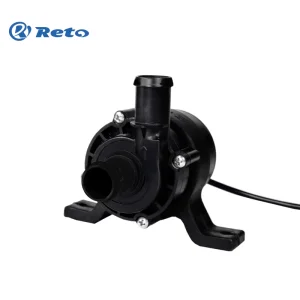
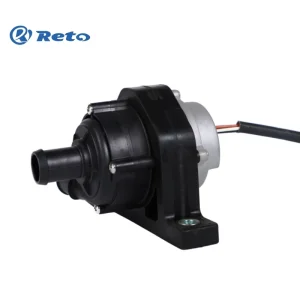
Yes. RETO maintains full in-house tooling, mold injection, and precision CNC fabrication facilities. We routinely customize inlet/outlet orientations (inline, 90-degree orthogonal, or quick-connect barb fittings in 1/4", 3/8", 1/2", 3/4" BSP/NPT threads), integrated vibration-damping bracket rubber compounds, and automotive-grade wiring harnesses (such as Deutsch DT, AMP Superseal, or Molex connectors).
How does RETO prevent cavitation and impeller erosion in hot water circulation loops?
Hot water applications (above 70°C to 100°C) experience sharp drops in vapor pressure, increasing cavitation danger. We address this via custom CFD-optimized volute suction designs that reduce NPSHr (Net Positive Suction Head required) below 0.8 meters. Moreover, high-temperature engineering polymers (such as PPS reinforced with 40% glass fiber) resist bubble-implosion pitting, guaranteeing consistent hydraulic head throughout the heater’s operational lifespan.
What internal electronic protection algorithms are integrated into RETO pumps?
Our micro-controller units (MCU) host robust firmware features: Dry-Run Protection (shuts down motor within seconds if no water resistance is detected, re-attempting every few minutes), Blocked-Rotor / Anti-Lock Protection (automatically cuts current if debris jams the impeller, preventing coil thermal runaway), Reverse Polarity Protection (protects driver against incorrect harness wiring), and Over-Voltage/Over-Current clamping.
What is the standard production lead time and minimum order quantity (MOQ) for OEM orders?
Standard prototype evaluation samples ship within 5 to 7 business days from our Xiamen testing lab. For mass OEM manufacturing runs, standard production lead times are typically 20 to 30 calendar days. Our automated and semi-automated production lines handle volume batches easily with standard MOQs starting at 500 to 1,000 units depending on customization requirements, backed by an annual production capacity surpassing 2,000,000 units.