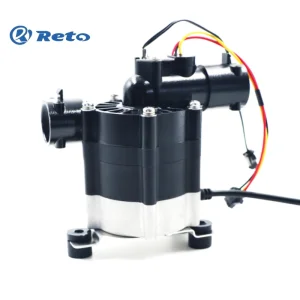
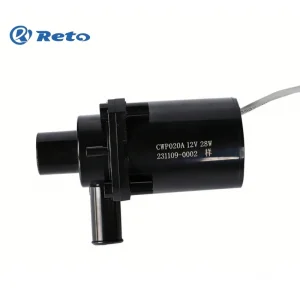
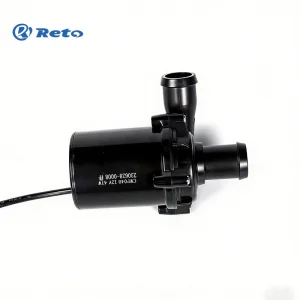
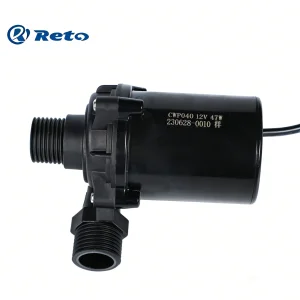
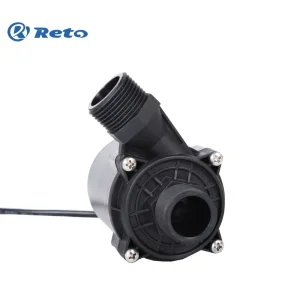
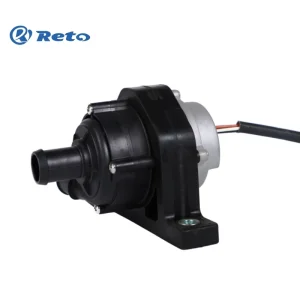
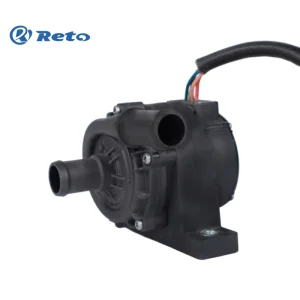
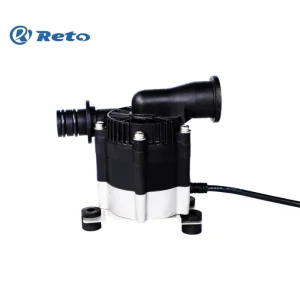
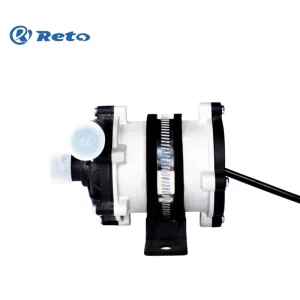
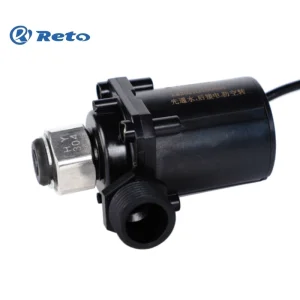
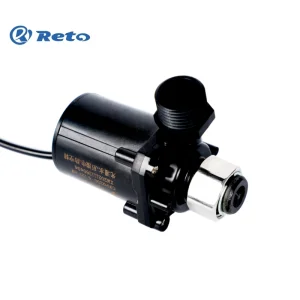
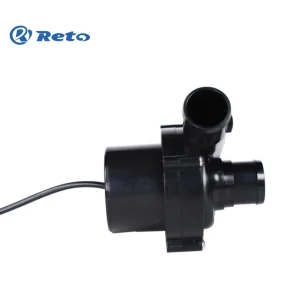
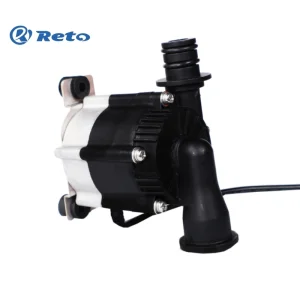
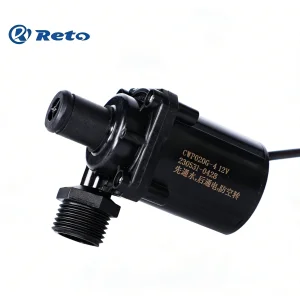
Direct hydraulic integration units calibrated for sanitary appliances, high-pressure bidet loops, thermal recirculation systems, and automated low-vibration continuous-duty circuits.
How Modern Brushless DC Architecture is Revolutionizing Micro-Hydraulics across Commercial Appliances and Closed-Loop Systems.
Unlike brushed DC or AC shaded-pole variants, modern in line booster factories rely on 3-phase electronically commutated brushless architecture. Eliminating physical commutators results in zero friction wear, MTBF surpassing 30,000 continuous hours, virtually silent acoustic footprints (<38 dB(A)), and exceptional power density within space-constrained housings.
Traditional shaft seals present persistent failure points under repeated pressure transients. In line booster pumps engineered by RETO leverage magnetic coupling and hermetically isolated canned-rotor enclosures. Static EPDM or Viton fluorosilicone O-rings guarantee absolute leak-tight isolation between energized stator windings and media conduits up to 100°C.
Modern commercial infrastructure demands instantaneous hydraulic response. Built-in microcontrollers support PWM signal modulation, linear speed tracking, and FG tachometer outputs. Integrated sensors mitigate dry-run cavitation, over-current stall, reverse polarity, and thermal runaway, offering direct telemetry to host system mainboards.
Engineering Consensus: "In line pressure booster pump units must simultaneously balance high dynamic static head with precise low-flow control. In applications such as smart toilet bidet jets and tankless instant heating manifolds, a pressure deviation of merely 0.05 MPa significantly impacts user perception and device longevity. Precision OEM injection tooling combined with hydrodynamic impeller profiling represents the boundary between consumer satisfaction and catastrophic line leakage."
Cross-functional integration strategies solving hydraulic volatility across modern appliances, mobility systems, and high-spec industrial circuits.
Municipal water pressures in multi-story residential developments fluctuate radically between 0.08 MPa and 0.45 MPa. Integrated 12V/24V in line booster assemblies decouple the sanitary appliance from municipal mains volatility, stabilizing wash-wand delivery velocity, nozzle aerated sprays, and rim flush vacuums with pinpoint volumetric consistency.
Traditional hot water delivery suffers extensive delays, venting potable water down drains while waiting for thermal stabilization. High-temperature 36V in line recirculation and booster pumps maintain an automated return loop within closed manifolds, maintaining instant hot delivery, suppressing water hammer, and overcoming tight pipe friction losses.
In ultra-fast DC supercharger networks and electric vehicle battery trays, heat dissipation bottlenecks limit continuous megawatt-level throughput. Automotive-grade IATF 16949 compliant in line auxiliary booster pumps push glycol-water solutions through tight cold-plate serpentine channels, dampening localized hot spots across high-voltage cells.
Point-of-Use (POU) reverse osmosis filtration requires continuous driving head to force fluid across semi-permeable membranes without causing membrane fouling or excessive concentrate runoff. High-pressure in line booster micro-pumps ensure stable permeate production rates regardless of seasonal plumbing temperature drops.
Industrial laser cutting optics, CNC spindles, and semiconductor testing fixtures generate concentrated heat flux. In line booster configurations provide pulsation-free, smooth hydrodynamic profiles that avoid resonance vibration within sensitive optomechanical tooling, safeguarding mirror alignments and sensor calibration.
Precision espresso machines, automated coffee kiosks, and microbrewing apparatus require food-safe components (NSF/FDA grade ceramics, PPS polymer heads) delivering repeatable pressure ramp-up curves during extraction without imparting mechanical vibrations or acoustic disturbances to front-of-house hospitality environments.
How next-generation motor control, material science, and predictive IoT telemetry will define tomorrow's in line boosting platforms.
Transitioning from discrete Hall-effect sensors to advanced Field-Oriented Control (FOC) eliminates electromagnetic failures in hot water zones. FOC reduces harmonic distortion, lowers active power consumption by an additional 14%, and guarantees ultra-smooth torque across low-RPM priming phases.
Embedding micro-scale MCU chips directly into the stator encapsulation enables continuous vibration frequency recording, current draw profiling, and operating hour tracking. In line pumps can transmit real-time degradation indices via LIN-bus or Modbus, pre-emptively alerting maintenance squads before hydraulic loss occurs.
Next-generation booster assemblies utilize high-purity Silicon Carbide (SiC) shafts, precision Zirconia ceramic thrust bearings, and carbon fiber reinforced PPS impellers. These chemical-resistant configurations permit broad temperature tolerances (-30°C to +125°C) and resistance to aggressive scaling in hard water territories.
A data-backed evaluation criteria for OEM procurement executives and chief mechanical architects.
| Evaluation Parameter | RETO High-Efficiency BLDC In Line | Legacy Brushed DC Pump | Conventional AC Booster Pump |
|---|---|---|---|
| Operating Lifespan (MTBF) | 25,000 – 40,000+ Continuous Hours | 1,500 – 3,500 Hours (Carbon wear) | 8,000 – 15,000 Hours (Thermal stress) |
| Acoustic Emission Level | < 35 to 40 dB(A) @ 1 Meter | 52 to 65 dB(A) (Mechanical noise) | 45 to 58 dB(A) (50/60Hz electromagnetic hum) |
| Energy Conversion Efficiency | 75% – 88% Dynamic Efficiency | 40% – 55% (High frictional losses) | 35% – 60% (Shaded pole / Capacitor run) |
| Speed & Pressure Modulation | Infinite Linear PWM / 0-5V Analog Control | Crude Voltage Stepping Only | Requires Bulky External Inverter / Fixed Speed |
| EMI & Sparking Hazards | Zero Arcing, Class B CISPR/EN 55014-1 Compliant | Severe Commutator Sparking & Arc EMI | Minimal Arcing, Moderate Inductive Surges |
| Form Factor & Weight Density | Ultra-Compact (PPS/PPO Core: 250g - 650g) | Moderate (Bulky brush block) | Heavy (Cast iron/copper laminations: 2kg - 6kg) |
Inside the Xiamen Manufacturing Base: How automated winding, automated assembly, and strict IATF protocols create uncompromised production consistency.
Hydraulic cavitation and premature bearing degradation stem directly from micro-gram rotational eccentricity. RETO's fully automated dynamic balancing cells mill or inject counterweights directly onto the magnet-rotor assembly, keeping dynamic unbalance below 0.05g·mm—eliminating resonant frequencies inside customer equipment.
Water immersion bubble testing cannot reliably detect micro-fissures in pressurized composite casings. Every in line booster pump unit undergoes automated high-vacuum helium mass spectrometer leak detection. With a seal rejection baseline of 1x10^-6 mbar·L/s, zero sub-surface porous leaks reach mass fulfillment batches.
Operating out of Tong'an District, Xiamen, our supply perimeter sources silicon steel laminations, enamelled copper wire, engineering PPS/PPO resins, and automotive-grade driver chips from audited tier-1 suppliers within a 150km industrial cluster, providing robust inventory buffers against geopolitical maritime disruptions.
A multi-point audit checklist for evaluating supply partner technical competence, process controls, and delivery predictability.
Auditing the factory's MES capability to track each pump's serial number back to raw copper coil heats, resin batch lot numbers, operator station timestamps, and precise EOL hydraulic test curves.
In-house CNC prototyping, SLA 3D resin hydro-cavity printing, and dynamic modal analysis that reduce standard iteration turnaround from conventional 90-day cycles down to 14 days.
In-house testing regimens covering thermal cycling (-40°C to +120°C), accelerated lifecycle pressure pulsation hammer (100,000 cycles @ 1.2 MPa), salt spray corrosion, and continuous dry-run durability.
Avoid bureaucratic sales-only communication channels. RETO pairs OEM accounts directly with senior motor, structural, and electronics lead engineers across all development gates.
Pre-validated material matrices and audited production nodes that facilitate friction-free global customs entry and end-market compliance.
Wet-end pump chambers are molded from virgin, non-recycled NSF/ANSI 61 and WRAS certified polyphenylene sulfide (PPS) and polyoxymethylene (POM). Wetted materials remain chemically inert, eliminating lead leaching, bisphenol emissions, and unpleasant plastic odours inside beverage and potable water systems.
Certified under automotive-grade quality disciplines, our operational lines implement APQP, FMEA, PPAP, and MSA tools. These stringent controls assure low PPM defect rates, mission-critical operational predictability, and standardized dimensional repeatability for EV suppliers and Tier-1 appliance OEMs alike.
Eliminating hazardous heavy metals, plasticizers, and persistent bio-accumulative substances ensures compliant distribution throughout North America and the European Union. Low-voltage DC brushless platforms meet CE safety criteria and streamline overall UL host appliance approval cycles.
Addressing core mechanical, hydraulic, electrical, and commercial inquiries encountered during custom in line booster pump procurement.
Explore additional certified configurations engineered for high-temperature recirculation, instant water heaters, solar thermal collection, and mobile liquid cooling loops.