Pre-engineered, low-noise, and vibration-resistant brushless auxiliary water pumps qualified for continuous thermal loop control in Canadian automotive programs.
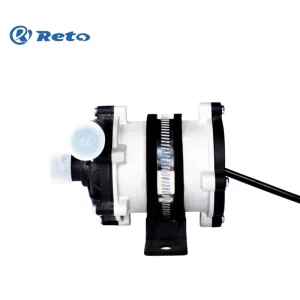
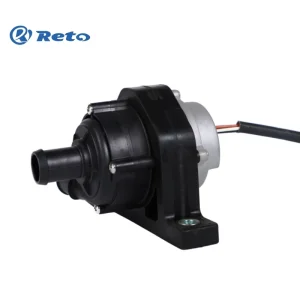
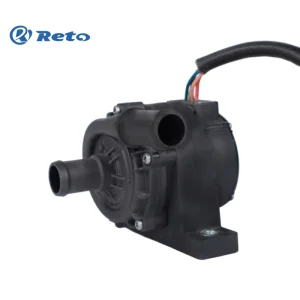
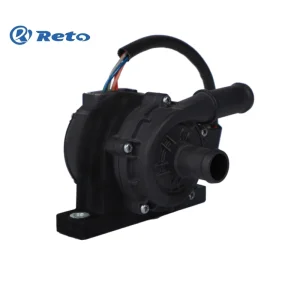
The Greater Toronto Area (GTA) and the wider Southern Ontario automotive corridor—spanning Windsor, London, Kitchener-Waterloo, Cambridge, Oakville, Oshawa, and Markham—form the epicentre of Canada’s multi-billion-dollar automotive manufacturing sector. Historically celebrated for internal combustion engine (ICE) assembly plants operated by General Motors, Ford Motor Company, Stellantis, Toyota, and Honda, the region is now undergoing an unprecedented multi-billion-dollar industrial renaissance driven by the global transition toward Electrification, Zero-Emission Mobility, and Advanced Clean Energy Powertrains.
With major flagship initiatives such as the Stellantis-LG NextStar Energy gigafactory in Windsor, the Volkswagen-PowerCo cell facility in St. Thomas, and re-tooled electric commercial van and passenger EV lines in Ingersoll and Oakville, the local demand for advanced liquid thermal management components has spiked dramatically. In this fast-evolving environment, mechanical belt-driven water pumps are rapidly being phased out. Today's automotive architectures require intelligent, variable-speed electric water pumps (EWPs) powered by precision Brushless Direct Current (BLDC) motors capable of micro-regulating temperatures across battery packs, power electronics inverters, electric drive units (EDUs), and climate heat-pump subsystems.
Close alignment with major Ontario-headquartered multinational Tier-1 component aggregators (including Magna International, Linamar, and Martinrea) requiring reliable sub-tier hydraulic pump manufacturing partners.
Direct supply capability into Canadian battery energy storage systems (BESS), electrified urban delivery fleets, light commercial vehicles (LCVs), and commercial bus electrification programs.
Strategic logistics enabling fluid integration within the bi-national Great Lakes automotive corridor connecting Ontario directly with Michigan, Ohio, and Indiana manufacturing plants.
Why Toronto Tier-1 suppliers and global automotive system architects specify our brushless magnetic-drive pumps for critical vehicle powertrain loops.
Traditional automotive coolant pumps relied on mechanical belt drives that rotated continuously with crankshaft speed, consuming excessive parasitic engine power and offering zero thermal autonomy when the vehicle was stationary or during start-stop events. In contrast, modern electric water pumps manufactured for the Toronto market feature electronically commutated three-phase BLDC motors paired with a hermetically sealed magnetic drive design.
By isolating the stator coils from the working fluid via a high-strength engineering plastic isolation sleeve (such as PPS or PPA with 30-40% glass fiber reinforcement), we completely eliminate dynamic mechanical face seals. Dynamic shaft seals represent the primary failure vector in legacy water pumps—prone to leakage, micro-fissuring, and catastrophic coolant contamination. Our magnetic wet-rotor architecture ensures absolute hermetic sealing, zero leakage over 30,000 continuous operating hours, and frictionless hydrodynamic ceramic shaft bearings lubricated exclusively by the 50/50 ethylene glycol and water coolant mixture itself.
Unlike fixed-RPM pumps, our pumps feature integrated smart microcontrollers that accept Pulse Width Modulation (PWM) or Local Interconnect Network (LIN 2.x) signals. Fluid delivery is matched precisely to transient heat fluxes, decreasing vehicle electrical parasitics by up to 85% compared to mechanical pumps.
Firmware incorporates multi-tier onboard diagnostics: stall protection, dry-run cut-off, over-temperature thermal de-rating, over-voltage/reverse-polarity clamps, and real-time diagnostic error feedback back to the central Vehicle Control Unit (VCU).
| Performance Metric | Legacy Mechanical Pump | Standard Brushed DC Pump | RETO Intelligent BLDC EWP (OEM Grade) |
|---|---|---|---|
| Motor Type | Engine Belt / Crankshaft | Carbon Brushed 12V DC | 3-Phase Sensorless BLDC |
| Shaft Sealing | Dynamic Mechanical Carbon-Ceramic | Elastomer Lip / Rotary Seal | Static Magnetic Seal-Less Isolation |
| Operating Lifespan | 60,000 - 100,000 km | 3,000 - 5,000 operating hours | > 30,000 operating hours (L10) |
| Acoustic Emission | Medium-High (Mechanical whine) | High (Brush arcing & friction) | ≤ 40 dB(A) at 1 meter |
| Speed Control Dynamics | Fixed directly to Engine RPM | Voltage Dropping (Inefficient) | Infinite Variable (PWM / LIN 2.1) |
| Operating Temperature | Engine Bay Limit (Max 105°C) | -20°C to +80°C | -40°C to +125°C Continuous |
| EMC Compliance | N/A (Passive mechanical) | CISPR 25 Class 2 (High RF noise) | CISPR 25 Class 5 Compliant |
Operating automotive hydraulic pumps in Canada, particularly throughout Ontario's freeze-thaw cycles and Northern cold fronts, presents extreme physical challenges that standard consumer-grade water pumps cannot survive. When ambient temperatures plunge to -40°C, commercial 50/50 ethylene glycol and water coolant solutions undergo dramatic viscosity spikes, transforming from low-resistance fluids into thick, syrupy media. This puts enormous starting torque burdens on the electric motor rotor and can induce severe fluid cavitation.
To address these conditions, our engineering team utilizes high-coercivity Neodymium-Iron-Boron (NdFeB) permanent magnets rated for high thermal demagnetization resistance (SH/UH grades). Proprietary high-torque startup software algorithms deliver stepped commutation patterns during initial cold-start cranking, overcoming viscous resistance without exceeding current limit thresholds or blowing system fuses.
Precision-ground ultra-smooth zirconium oxide (ZrO2) ceramic shafts and high-purity carbon-graphite bushings provide virtually zero thermal expansion mismatch, preventing rotor seizure in severe sub-zero cold soaking.
Intelligent closed-loop back-EMF sensing identifies fluid shear drag on startup. The internal controller automatically modulates current supply and ramp-up timing to avoid stalling in heavy viscous slush.
Engineered to resist aggressive road de-icing salts (calcium chloride and magnesium chloride) used heavily on Ontario highways (401, 400, QEW) through specialized e-coating and high-grade polyphenylene sulfide composite housings.
Sourcing managers within global automotive manufacturing companies and Toronto Tier-1 enterprises maintain zero tolerance for component variation or supply instability. A single coolant pump failure in an electric vehicle can lead to severe thermal runaway, battery shutdown, or drive inverter burnout. Consequently, our manufacturing ecosystem is governed by rigorous automotive compliance frameworks:
Every automotive-grade BLDC pump is built in automated clean-room assembly lines following Production Part Approval Process (PPAP Level 3) protocols, including comprehensive Design Failure Mode and Effect Analysis (DFMEA) and Process Failure Mode and Effect Analysis (PFMEA).
Electric vehicle thermal loops run in close proximity to sensitive high-voltage cabling and onboard telematics. Our internal electronic drive circuitry is shielded to achieve CISPR 25 Class 5 EMC emission ratings, preventing interference with GPS, ADAS radar, and vehicle radio frequencies.
Engineered to assist powertrain developers in reaching ASIL-B functional safety goals with dual independent speed feedback (FG pulse signal), hardware-based fault detection lines, and fail-safe limp-home operational capability.
Every single pump unit leaves the automated line only after completing computerized testing for helium dry-leak tightness, hydraulic pressure-vs-flow (Q-H) curve verification, power draw tolerance, and acoustic noise spectrum profiling.
For North American Tier-1 procurement teams operating under the United States-Mexico-Canada Agreement (USMCA / CUSMA), we provide fully transparent traceability, documented country-of-origin certification, and complete material data sheets via the International Material Data System (IMDS), ensuring complete compliance with REACH and RoHS standards.
As the Toronto automotive corridor pushes toward 800V fast-charging architectures (enabling 10% to 80% state-of-charge replenishment within 15 minutes), heat rejection spikes dramatically. Future thermal architectures are transitioning from discrete, hose-connected single water pumps to fully integrated multi-port thermal control modules (combining variable-speed BLDC pumps, multi-way rotary valves, expansion tanks, and plate heat exchangers into a single compact sub-assembly).
Our technological roadmap is heavily focused on three strategic development pillars engineered specifically for North American OEM deployment:
Next-generation inverter controllers utilizing SiC switches to achieve 92%+ motor driver efficiency, reducing heat generation inside the pump's own electronic casing during heavy continuous high-ambient operation.
Implementation of CAN-FD protocol integration allowing millisecond-level telemetry transmission, including rotor speed, stator winding temperature, fluid temperature estimates, and predictive bearing wear analysis.
Modular flanged pump designs allowing direct cartridge bolt-on integration into structural battery pack bulkheads and thermal octopus manifolds, slashing vehicle plumbing weight and potential joint leakage paths.
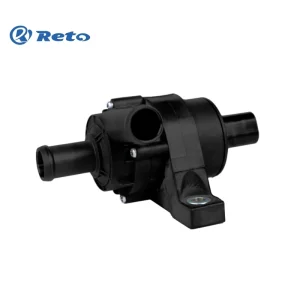
A comprehensive lineup of auxiliary electric water pumps, high-pressure circulation units, and compact DC pumps tailored for commercial vehicle, passenger car, and off-highway vehicle electrification.
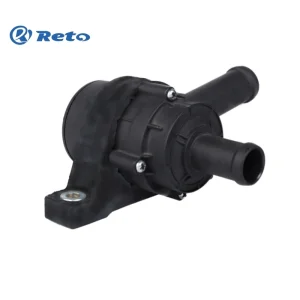
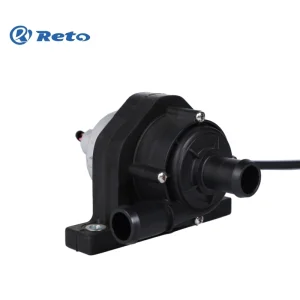
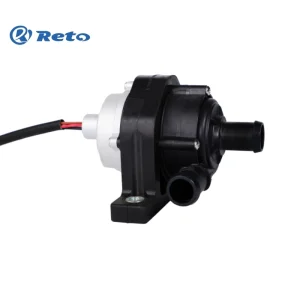
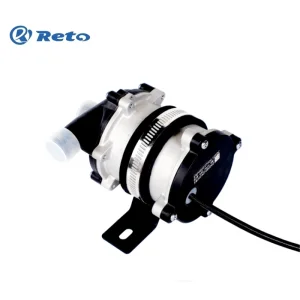
In-depth responses covering engineering integration, testing validation, lead times, and quality certifications for North American automotive buyers.
Our automotive pumps are designed with high-density neodymium magnets specifically stabilized against cryogenic embrittlement and thermal demagnetization. We pair high-purity zirconia ceramic shafts with carbon-graphite bearings that maintain a uniform coefficient of thermal expansion, preventing rotor lockup during -40°C overnight cold soaks. In addition, the internal MCU firmware executes a stepped startup current sequence designed to break through the severe viscosity spikes characteristic of cold 50/50 ethylene glycol and water mixtures.
We supply complete IATF 16949:2016 audited quality dossiers for every OEM manufacturing program. Our engineering team can provide complete Production Part Approval Process (PPAP) Level 3 documentation packages, including DFMEA, PFMEA, Control Plans, Process Capability studies (Cpk ≥ 1.67), Gage R&R, full dimensional inspection layouts, and IMDS material submissions.
Yes. We frequently develop bespoke pump configurations for vehicle integrators. Customization capabilities include modifying impeller trim and volute geometry to adjust Q-H curves (pressure vs. flow), selecting specific quick-connect barb or SAE flanged fluid ports, tailoring custom anti-vibration bracket orientations, and configuring communication interfaces including PWM (frequencies from 50Hz to 1000Hz), LIN 2.1/2.2 bus with customized diagnostic DTC lookup tables, or CAN 2.0B / CAN-FD.
Traditional automotive water pumps utilize mechanical face seals that rely on dynamic contact between rotating and stationary rings. These seals eventually wear down, degrade due to coolant particulate abrasion, or dry out, leading to weeping and eventual catastrophic coolant loss. Our magnetic drive pumps use a static isolation can that separates the fluid chamber from the dry motor stator completely. There are no dynamic seals to wear out, resulting in a hermetic, zero-leak seal rated for continuous operation exceeding 30,000 hours.
Standard engineering evaluation samples for bench testing and thermal test-rig validation can be dispatched within 5 to 7 business days. For customized housings, bespoke impeller molds, or proprietary electronic controller software revisions, the typical DVP&R (Design Verification Plan and Report) tooling and sample cycle requires 4 to 6 weeks. Mass production ramp-up with automated End-of-Line testing generally operates on a 4 to 8-week production schedule with flexible freight forwarding options to Toronto, Detroit, or direct to your North American 3PL warehouse.
Electrification introduces strong electromagnetic fields and delicate communication networks in tight engine compartments. Our internal motor control boards feature multi-stage input filtering, ferrite bead chokes, optimized PCB trace return paths, and dedicated hardware snubbers to attenuate high-frequency switching harmonics. All automotive-grade pump models are pre-validated to meet or exceed CISPR 25 Class 5 conducted and radiated emissions, and can withstand ISO 7637-2 and ISO 16750-2 electrical disturbance transients.
Whether you require drop-in replacement auxiliary electric pumps or a custom-developed thermal loop circulation pump for your vehicle program, our technical team is ready to evaluate your specifications.