Engineered for sustained thermal performance under demanding Pacific Northwest conditions—from marine port transit shuttles to high-mileage EV delivery fleets across King County.
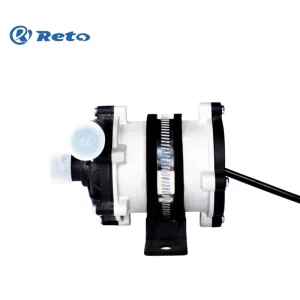
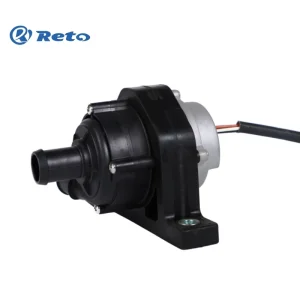
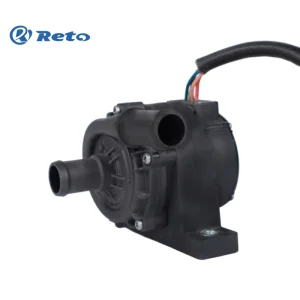
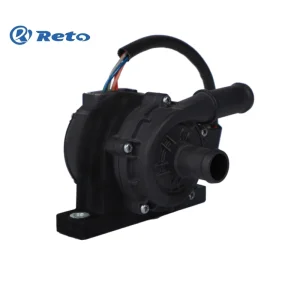
Analyzing the convergent technical requirements of commercial fleet electrification, maritime hybrid systems, and aerospace ground infrastructure across the greater Puget Sound region.
With corporate headquarters and engineering centers for leading heavy-duty truck manufacturers (such as PACCAR/Kenworth) anchored in the Seattle-Bellevue-Renton corridor, regional demand for automotive electric pumps has pivoted from traditional engine-belt drives to high-voltage, multi-loop electronic systems. Electric Class 8 chassis require distinct thermal circuits for silicon-carbide (SiC) inverters, dual traction motors, and megawatt charging interfaces, demanding continuous flow rates exceeding 65 L/min under continuous operational stresses.
As the global epicentre of e-commerce logistics, Seattle serves as the live proving ground for tens of thousands of commercial EV delivery vans operating daily from Everett down to Tacoma. Constant start-stop duty cycles, variable Pacific Northwest ambient moisture, and rapid seasonal temperature drops place high demands on auxiliary circulation pumps. These units must maintain cabin defrosting and preserve strict 20°C to 30°C traction battery core temperatures to avoid regenerative braking throttling.
The Northwest Seaport Alliance and Seattle-Tacoma International Airport (SEA) are executing aggressive decarbonization programs. Ground support equipment (aircraft tugs, belt loaders, cargo tractors) and hybrid passenger vessel auxiliary power units (APUs) require IP6K9K waterproof brushless DC coolant pumps resistant to saline air corrosion, mechanical vibration, and rapid load cycling during high-throughput cargo operations.
Procuring automotive pumps requires balancing mechanical hydraulic efficiency, electronics integration, functional safety certification, and total life-cycle economics.
Modern vehicle architectures cannot tolerate electrical noise that compromises high-speed sensor arrays or autonomous drive compute boards. OEM engineering teams in Washington require pumps compliant with CISPR 25 Class 5 limits for conducted and radiated emissions. RETO integrates advanced 3-phase Field-Oriented Control sensorless drive electronics, utilizing optimized vector algorithms that eliminate torque ripple, slash harmonic vibration, and dramatically curtail acoustic propagation throughout the vehicle frame.
Traditional automotive water pumps with mechanical face seals suffer from wear, particle ingress, and chemical breakdown over extended operating life. Our BLDC platform utilizes a hermetically isolated stainless steel or polyphenylene sulfide (PPS) canister that completely separates the stator windings from the pumped glycol-water mixture. The wet-rotor design utilizes high-purity ceramic shafts and self-lubricating carbon-graphite bushings, providing virtually zero leak paths and an operational lifespan exceeding 30,000 continuous hours.
Addressing multi-voltage architectures, functional safety compliance, and aggressive cooling dynamics across automotive, hydrogen, and computing applications.
As vehicle architectures migrate to 800V to enable 350kW extreme fast-charging (XFC), thermal management circuits must dissipate up to 25kW of waste heat during 15-minute charge windows. Our high-voltage compatible auxiliary cooling pumps feature intelligent PWM/LIN-bus feedback, modulating coolant mass flow dynamically to maintain module-to-module cell temperature delta within strict ±2°C windows, thereby suppressing thermal runaway risks.
Fuel cell electric trucks tested throughout the Pacific Northwest require specialized non-conductive fluid loops to prevent electrical leakage through the stack. We engineer specialized pumps utilizing high-purity virgin PEEK impellers, ion-leaching-resistant EPDM O-rings, and passivated wetted surfaces, ensuring absolute zero ionic contamination and sustaining coolant conductivity levels below 5 µS/cm over the lifetime of the fuel cell stack.
Level 3 and Level 4 autonomous vehicle development in the Seattle tech sector requires liquid cooling systems for in-vehicle supercomputers (consuming 1.5kW to 3kW of compute power). Our mini BLDC pumps deliver compact integration footprints, high differential pressure heads to overcome dense micro-channel liquid cold plate resistance, and sub-35dB acoustic dampening to preserve quiet vehicle cabins.
Continuous investment in sensorless commutation algorithms, integrated micro-valves, and digital-twin predictive maintenance telemetry.
Direct integration of high-bandwidth LIN/CAN communication modules into the pump controller housing. Enables real-time diagnostic reporting (rotor stall detection, dry-run protection, over-temperature throttling, input voltage transient monitoring).
Eliminating discrete driver PCBs by integrating bare-die power MOSFETs directly onto thermally conductive insulated metal substrates (IMS). Delivers a 30% volume reduction, enhanced power density, and elevated thermal tolerance up to 135°C ambient.
Developing unified multi-port thermal switching blocks combining dual BLDC circulation pumps with 4-way and 5-way proportional rotary coolant valves. Streamlines OEM assembly time, reduces vehicle hose routing, and drops pressure head losses by 18%.
Firmware-embedded machine learning edge models monitoring back-EMF phase current ripples to forecast bearing wear, coolant degradation, and micro-cavitation. Sends proactive fleet maintenance alerts well ahead of mechanical degradation.
Combining fully automated coil-winding and balancing lines with stringent automotive-grade validation processes for North American buyers.
Every single rotor undergoes dual-plane automated dynamic balancing down to G1.0 balancing quality grade, minimizing eccentric radial forces that accelerate bearing fatigue. In addition, pump electronics are encapsulated with vacuum-degassed, high-thermal-conductivity automotive epoxy resins, guaranteeing unyielding ingress protection (IP67 and IP6K9K) against direct high-pressure steam cleaning and road salt splash.
Our quality verification processes employ automated End-of-Line (EOL) testing cells for every manufactured automotive pump. Testing sequences include helium mass spectrometer vacuum leak verification (capable of detecting leakage rates down to 10⁻⁶ mbar·L/s), full-sweep P-Q hydraulic flow head mapping, electrical hi-pot insulation breakdown testing (up to 2,500V), and CAN/LIN communication handshake validation.
To support Tier-1 integrators and fleet converters in Washington State and the greater Pacific Northwest, our supply network leverages direct intermodal logistics through the Port of Seattle and Port of Tacoma. We provide scheduled Just-In-Time (JIT) deliveries, bonded warehouse buffers, and localized safety stock options that safeguard production schedules against trans-Pacific supply fluctuations.
Ensuring end-to-end design verification aligned with US DOT, SAE, UL, and environmental sustainability mandates.
Every automotive pump engineered for North American deployment complies strictly with SAE J1455 environmental practices for heavy-duty commercial vehicle equipment, as well as ISO 16750 road vehicle electrical/mechanical standards. Design criteria account for wide operating temperatures (-40°C to +125°C), thermal shock cycling (-40°C to +120°C in under 10 seconds), sinusoidal and random vibration profiles (up to 4.5g RMS), and resistance to chemical exposures including de-icing salts, engine oils, and 50/50 ethylene glycol-water solutions.
We work directly alongside your thermal system architects. Our team provides detailed 3D CAD models (STEP/IGES), CFD hydraulic flow simulations of inlet and outlet port geometries, rapid prototyping via 5-axis CNC machining, and motor electrical modeling (BEMF and thermal de-rating curves). This collaborative co-design approach accelerates OEM development milestones from prototype mules to vehicle series production.
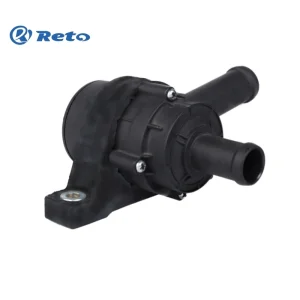
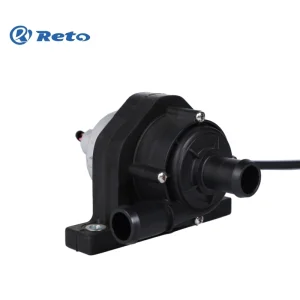
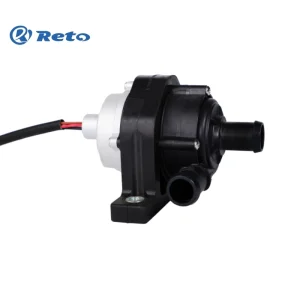
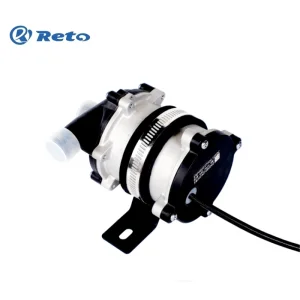
Explore our complete automotive lineup of BLDC coolant pumps, engineered for battery pack conditioning, electric drive motor chilling, and cab auxiliary climate regulation.
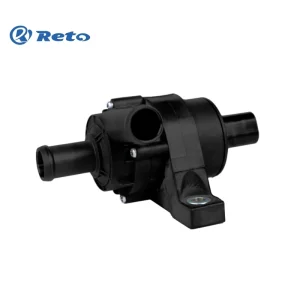
Expert answers addressing the practical technical challenges confronted by powertrain engineers and sourcing leads when evaluating custom BLDC pump architectures.
Traditional mechanical water pumps rely on internal combustion engine belt connections, tying their rotational speed directly to engine RPM rather than actual thermal demand. This results in severe parasitical drag, fuel consumption penalties, and cold-start inefficiencies. Brushless DC (BLDC) electric water pumps decouple circulation from engine speed, offering on-demand electronic speed control via PWM or LIN-bus. This delivers continuous power optimization, immediate cabin heating, and post-shutdown after-run cooling to protect turbos and power electronics.
Sub-zero temperatures across Washington State significantly increase the kinematic viscosity of standard 50/50 ethylene glycol-water mixtures, substantially raising startup torque requirements and increasing cavitation risk. RETO pumps incorporate specialized high-starting-torque firmware routines with current-vector ramping, ensuring positive motor lock-in without rotor skipping down to -40°C. Furthermore, our fluid dynamic impeller profiles feature optimized NPSHr (Net Positive Suction Head required) to suppress cavitation inception during high-viscosity cold circulation.
Our LIN 2.1/2.2 and CAN 2.0B interfaces transmit complete bidirectional diagnostic feedback directly to the central vehicle control unit (VCU). Feedback telemetry covers real-time operational RPM, internal controller temperature, phase-current draw, voltage transients, and diagnostic fault flags—including dry-running protection, locked rotor warning, impeller blockages, and over-pressure conditions, supporting comprehensive vehicle OBD-II compliance.
To prevent electromagnetic interference from disturbing sensitive sensor suites, millimeter-wave radar, and high-performance computing clusters in autonomous vehicle conversions, our pumps feature integrated multi-stage LC filters, shielded wiring options, and continuous-slope PWM switching that eliminates sharp voltage transitions (dV/dt). All models are designed and validated to meet CISPR 25 Class 4 and Class 5 requirements.
Yes. Over 70% of our automotive production involves tailored OEM configurations. We routinely modify inlet and outlet hose barbs (standard sizes include 16mm, 19mm, 22mm, 25mm, or custom quick-connect quick-release automotive fittings), adapt cast-aluminum and polymer mounting brackets with tuned vibration dampers, and integrate customer-specified automotive connectors (such as Delphi/Aptiv Metri-Pack, TE Connectivity, or Amphenol).
RETO operations are certified under the stringent IATF 16949 automotive quality management system, ISO 9001, and verified by TÜV Rheinland. Our production facilities deploy comprehensive Advanced Product Quality Planning (APQP), Production Part Approval Process (PPAP Level 3), statistical process control (SPC), Failure Mode and Effects Analysis (DFMEA/PFMEA), and 100% trace-serialized testing across critical manufacturing operations.
From initial hydraulic CFD simulation and customized bracket design to IATF 16949 mass production delivery for the Seattle and Pacific Northwest commercial mobility sectors, our engineering specialists are ready to collaborate.
Send Inquiry Now