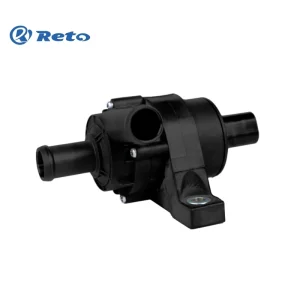
High-precision brushless DC (BLDC) automotive cooling solutions, EV battery thermal management pumps, and electronic auxiliary circulation units engineered for Alpine extreme duty cycles, cleantech innovation, and European automotive Tier-1 compliance.
Direct from our precision manufacturing facility: brushless DC pumps tailored for Swiss high-temperature coolant circuits, EV inverters, and heavy-duty hybrid drivetrains.
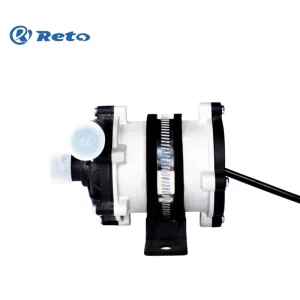
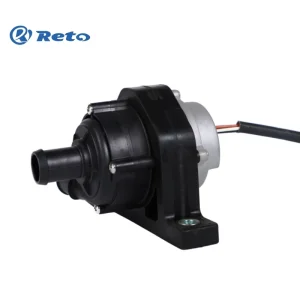
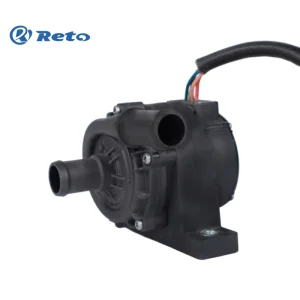
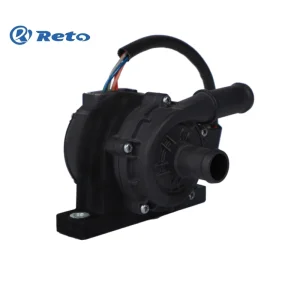
Switzerland does not harbor high-volume mass-passenger vehicle assembly lines like Germany or France, yet it functions as the intellectual powerhouse, precision engineering nursery, and Tier-1/Tier-2 mecca of Europe. From Winterthur and Biel/Bienne to the canton of Zurich and Romandy cleantech corridors, Swiss companies pioneer advanced electrification technologies, heavy-duty electric trucks (such as Designwerk and Hess electric transit buses), electric municipal utility fleets, precision mountain funiculars, and hydrogen fuel-cell pilot drives.
Operating within the rugged topography of the Swiss Alps presents harsh operational boundary conditions for automotive thermal management. Vehicles encounter rapid elevation variations exceeding 2,000 meters across mountain passes such as the Gotthard, San Bernardino, and Simplon. Ambient temperatures oscillate violently from -30°C winter blizzards to intense high-load uphill climbs under full battery discharge, demanding liquid cooling pumps that exhibit zero cavitation, superior mechanical shaft stability, instantaneous PWM modulation, and impervious protection against corrosive salt-spray de-icing solutions.
Request Engineering ConsultationElevation Pressure Differentials: Atmospheric pressure falls by ~25% at 2,500m elevation. Standard automotive pumps suffer from suction head degradation and catastrophic micro-cavitation, eroding plastic impellers and vapor-locking cooling circuits.
Severe Road-Salt Corrosion: Swiss winter roadway de-icing utilizes concentrated magnesium and calcium chloride. Ingress protection below true hermetic IP67/IP69K leads to stator coil short-circuiting.
Sub-Zero Fluid Viscosity Spikes: At -35°C, 50% water-glycol coolant mixtures thicken significantly. BLDC pumps without optimized sensorless start-up algorithms suffer stalled rotor errors during pre-heating cycles.
A rigorous benchmark demonstrating why our magnetic-drive brushless canned-rotor water pumps outperform traditional brushed and mechanically sealed units across mission-critical parameters.
| Performance Parameter | RETO Custom Automotive BLDC Pump (Swiss Spec) | Standard Brushless Aftermarket Pump | Legacy Brushed DC Mechanical Pump |
|---|---|---|---|
| Hydraulic Chamber Sealing | Canned-Rotor Hermetic Isolation (Static O-Ring, 0 Dynamic Seals) | Dynamic Mechanical Carbon Lip Seal (Prone to wear) | Standard Elastomer Shaft Seal (High leakage risk) |
| Continuous Service Life (MTBF) | > 25,000 Hours (Rated up to 30,000 hrs @ 85°C) | 8,000 – 12,000 Hours | 2,500 – 4,000 Hours (Limited by carbon brush wear) |
| Cold-Start Torque (-40°C) | High-Flux Neodymium NdFeB N42SH Magnet (Zero Stall) | Standard Ferrite / Bonded NdFeB Magnet | Weak initial torque with commutator contact resistance |
| Shaft & Bearing Metallurgy | High-Purity Zirconia Ceramic Shaft + Carbon Graphite Bearing | Stainless Steel 304 Shaft + Sintered Bronze Bushing | Hardened Carbon Steel + Roller Bearings |
| Electromagnetic Immunity (EMC) | CISPR 25 Class 5 Compliant, UN ECE R10 V-certified | CISPR 25 Class 2 or 3 (Interferes with high-frequency sensors) | Severe brush arcing, broad RF interference |
| Dynamic Speed & Control | Direct LIN 2.1 / CAN 2.0B / 100Hz-1kHz PWM Feedback | Basic PWM Speed Signal (No diagnostic telemetry) | Analog Voltage Variation Only (Inefficient) |
| Environmental Rating | True IP67 / IP69K (Hermetic epoxy potted stator) | IP65 (Splash-resistant only) | IP54 (Vulnerable to undercarriage washdown) |
How combining Swiss specification design standards with our IATF 16949-certified automated manufacturing base in Xiamen, China solves the critical trade-off between uncompromising quality and commercial competitiveness.
Automotive grade verification permeates every manufacturing stage. From PPAP Level 3 documentation, FMEA defect prevention, and full traceable serialization, every single pump undergoes 100% automated end-of-line testing for hydraulic flow curves, pressure head, dynamic leakage, and dielectric insulation.
Unlike assembly-only vendors, we engineer and control key sub-assemblies in-house: high-precision automated copper coil winding, SMT printed circuit board assembly (PCBA) with conformal silicone gel potting, clean-room mold injection of PPS polyphenylene sulfide pump casings, and CNC impeller balance calibration.
Swiss engineers pride themselves on fast iterative prototyping. Our dedicated R&D tooling laboratory turns around custom volute designs, unique barb/quick-connect hose fittings, and custom bracket topologies in as little as 14 business days, backed by mold flow analysis and CFD hydraulic modeling.
Real-world integration scenarios where our custom automotive pumps deliver performance across Switzerland's specialized e-mobility and industrial vehicle landscape.
During Swiss Alpine sub-zero parking, battery cells drop below optimal chemical thresholds. Our compact BLDC pumps cycle heated glycol through battery cold plates with precise low-flow volumetric rates, preventing dendrite formation and accelerating ultra-fast DC charging speeds even at -25°C in Engadin or Davos.
Electric 40-tonne commercial freight haulers operating between Basel, Bern, and Lugano undergo prolonged hill climbs followed by regenerative descent. We supply dual-pump redundant loops dedicated to dissipating heat from 350kW dual motors, Silicon Carbide (SiC) traction inverters, and transmission oil coolers.
Switzerland is leading European zero-emission hydrogen truck logistics. Fuel cell proton-exchange membranes (PEM) demand deionized water cooling loops free from conductive metallic ionic leeching. We provide ultra-pure engineered plastics (PPS/PPO) and deionized fluid-compatible water pumps.
Staying ahead of regulatory shifts, electrification milestones, and intelligent vehicle architectures.
As electric vehicles transition from 400V to 800V electrical bus platforms to achieve 15-minute ultra-fast charging, electromagnetic interference (EMI) surges exponentially. Automotive pumps must integrate advanced common-mode choke coils, shielded connector interfaces, and isolated galvanic PCB layouts to satisfy stringent European CISPR 25 Class 5 criteria.
Furthermore, SiC power modules run hotter in smaller packages, necessitating dynamic coolant response times under 0.8 seconds from idle to 6,000 RPM maximum impelling speed.
The automotive industry is phasing out disconnected auxiliary coolant circuits in favor of consolidated "Octovalve" or multi-port integrated manifolds. This requires pump manufacturers to deliver "flange-mount" or "manifold-integrated" pump bodies with no bulky external hose barbs.
RETO provides custom CNC aluminum or laser-welded composite housings designed to directly bolt onto manifold castings, saving space, cutting assembly weight by 35%, and eliminating potential leak paths.
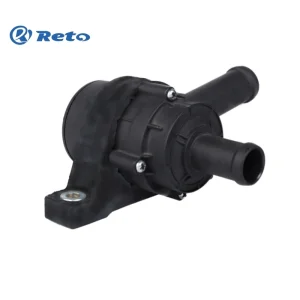
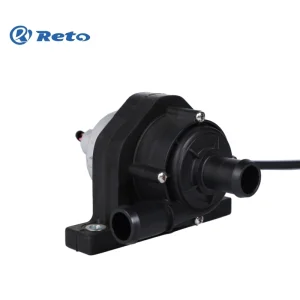
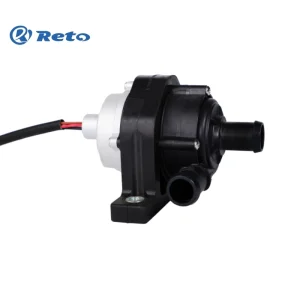
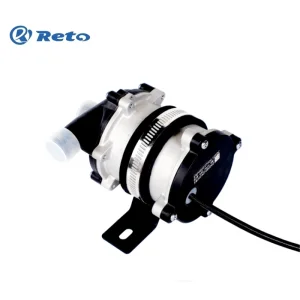
Browse our complete catalog of certified automotive pumps deployed across international EV thermal management systems and Swiss commercial fleets.
Stringent compliance frameworks ensuring seamless customs clearance, environmental conformity, and OEM auditing approval.
Electric components integrated into vehicles registered in Switzerland must comply with UN ECE Regulation 10 (Electromagnetic Compatibility). Our BLDC electronics are verified in accredited anechoic chambers, featuring dual low-pass filtering and shielding to guarantee zero interference with automotive radar, GPS, or cellular antennas.
Under the Swiss Chemical Risk Reduction Ordinance (ChemRRV) and EU REACH Annex XVII, all wet materials, wiring harness jackets, solder alloys, and plastic stabilizers must be certified lead-free, halogen-free, and phthalate-free. We supply verified third-party SGS/TÜV test certificates with every batch.
Automotive under-hood pumps face pressure washing and extreme thermal shock cycles (-40°C to 125°C in minutes). Our pumps utilize custom double fluorosilicone O-rings, vacuum ultrasonic welding, and pressurized dry-air differential testing at 2.5 bar, certified for IP67 and IP69K high-pressure steam ingress.
Comprehensive technical and commercial clarifications regarding custom BLDC automotive pump integration.
Our pumps integrate high-coercivity Neodymium NdFeB (N42SH) magnets rated to operate without demagnetization from -40°C to +150°C. Our embedded firmware utilizes a smart closed-loop start algorithm that delivers elevated initial breakaway torque to overcome high-viscosity chilled ethylene glycol mixtures without tripping over-current protection.
Yes. We regularly mold and CNC custom inlet/outlet diameters (standard 16mm, 19mm, 22mm, or custom SAE J2044 quick-connect fittings) and integrate Tier-1 automotive sealed connectors including TE Connectivity AMP Superseal, Deutsch DT04, or Hirschmann interfaces with custom pinouts.
We provide full PPAP (Production Part Approval Process) Level 3 packages, including Process Flow Diagrams, PFMEA, Control Plans, IMDS material submissions, Gage R&R studies, and full dimensional inspection reports from high-precision coordinate measuring machines (CMM).
In a traditional pump, a dynamic mechanical seal separates the motor from fluid. Over time, vibration, glycol crystal deposits, and temperature cycling cause seal hardening and leakage. In a canned-rotor pump, a non-magnetic stationary isolation can hermetically separates the stator windings from the fluid, completely eliminating dynamic shaft seals and catastrophic fluid leaks.
We offer DAP (Delivered at Place) or DDP (Delivered Duty Paid) air freight directly to Zurich (ZRH), Geneva (GVA), or Basel-Mulhouse (BSL) for prototyping and batch shipments, as well as multimodal sea-rail freight via Rotterdam or Hamburg into Swiss distribution centers, with complete EUR.1 / Free Trade Agreement documentation.
Standard sample units ship within 3 to 5 business days. Customized hydraulic volutes, modified windings, or custom control firmware take 2 to 3 weeks for prototype verification. Following PPAP approval, mass production orders are fulfilled within 4 to 6 weeks from our automated manufacturing lines in Xiamen.
Consult with our senior motor, hydraulic, and control systems engineering team. Whether you require customized 12V/24V BLDC electric water pumps, high-temperature auxiliary circulation, or silent EV battery thermal management solutions, we deliver production-ready excellence.